The Rolex Datejust Ref. 1630: The Rare Bird Behind the Land-Dweller

The Rolex Datejust Ref. 1630 is one of the strangest and most important vintage Rolex watches most collectors have never encountered.
Produced briefly during the 1970s, it combines the angular case and integrated bracelet later associated with the Oysterquartz with Rolex’s traditional automatic Calibre 1570. More recently, its significance has grown because Rolex identified the 1974 self-winding Datejust as part of the historical design lineage behind the modern Land-Dweller.
It looks like a quartz watch, runs like a classic mechanical Datejust, and connects two very different eras of Rolex design.
That unusual combination explains why collectors often call the Rolex 1630 the “Rare Bird.”
What Is the Rolex Datejust Ref. 1630?
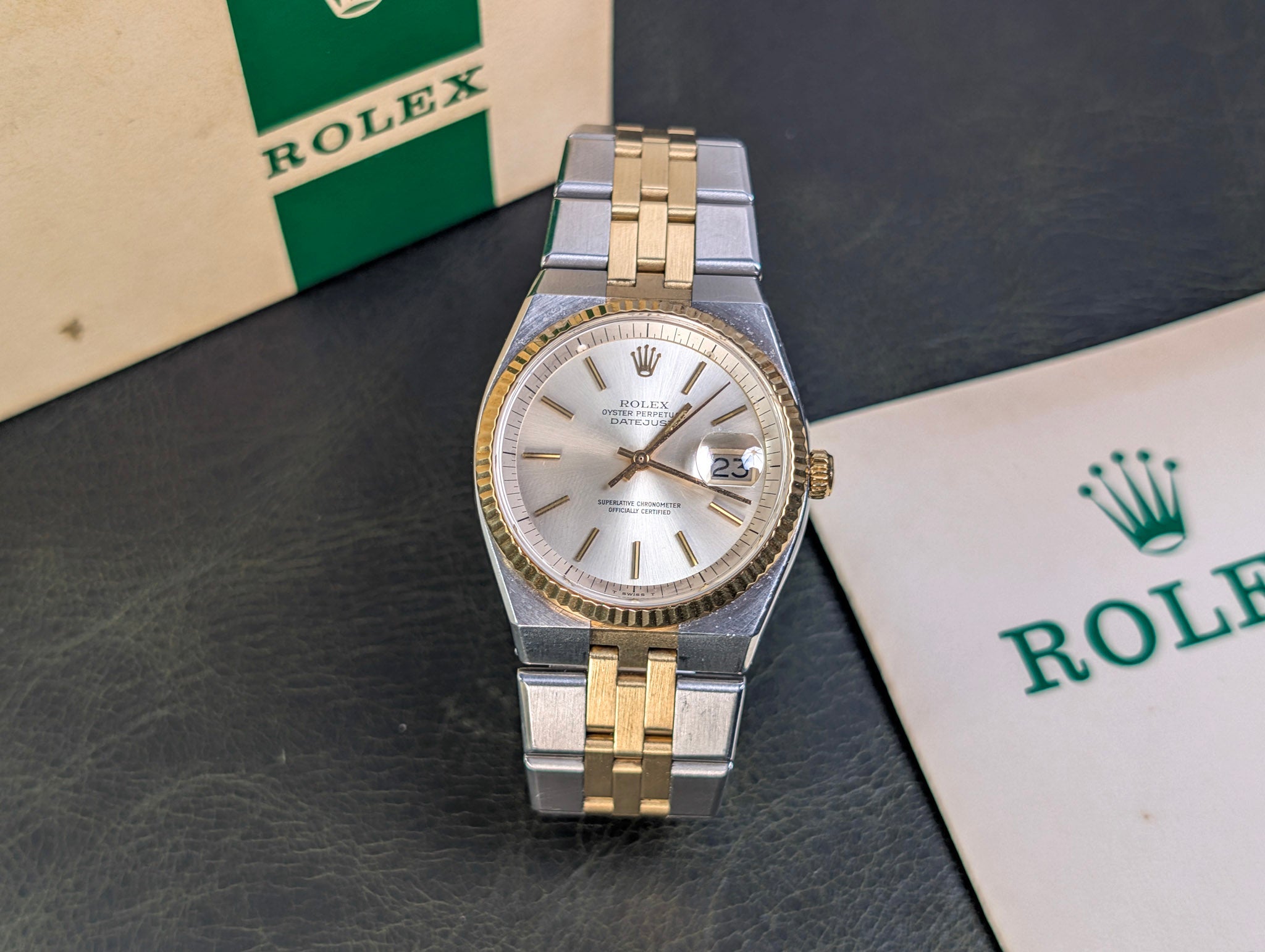
The Rolex Datejust Ref. 1630 is a 36mm steel-and-gold automatic watch produced during the mid-to-late 1970s.
Unlike a conventional Datejust from the period, it features a sharply faceted case and an integrated Jubilee-style bracelet that flows directly into the watch. Its architecture closely resembles the later Rolex Oysterquartz, but the Ref. 1630 is powered by the automatic Rolex Calibre 1570 rather than a quartz movement.
In simple terms, the Rolex 1630 is a mechanical Datejust housed inside one of the company’s most forward-looking 1970s designs.
Rolex and the Quartz Revolution
To understand why the Ref. 1630 exists, it helps to understand what was happening in the watch industry at the time.
By the end of the 1960s, quartz technology was beginning to reshape watchmaking. Electronic movements offered levels of accuracy that traditional mechanical watches could not easily match, and Swiss manufacturers faced increasing pressure to respond.
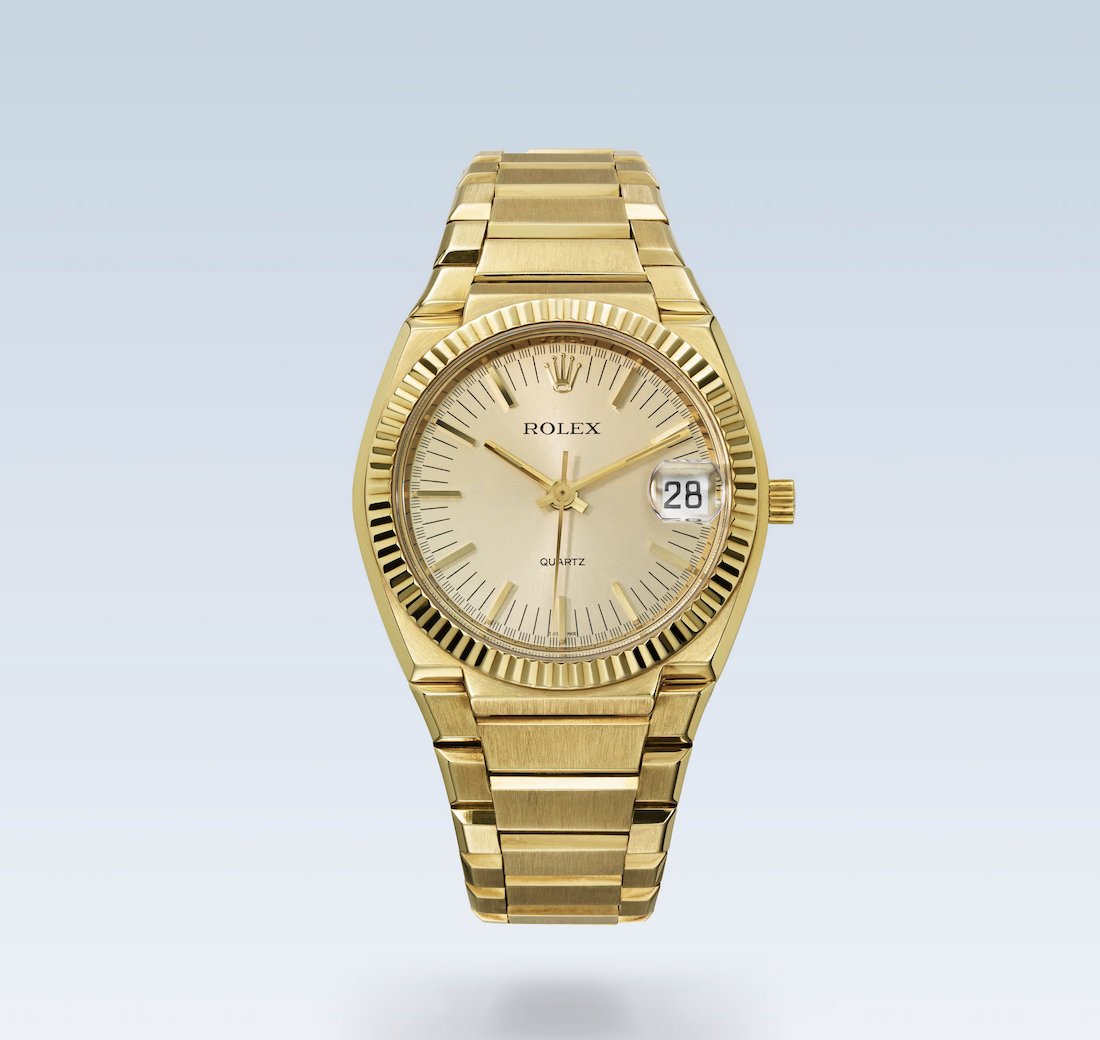
Rolex participated in the development of the Beta 21 quartz movement alongside other Swiss watch companies. It used that movement in the Rolex Ref. 5100, introduced around 1970.
The Ref. 5100 was Rolex’s first commercially available quartz watch. It was large, angular, made in precious metal, and fitted with an integrated bracelet. Its futuristic design looked dramatically different from the familiar Oyster Perpetual and Datejust models of the period.

The Beta 21, however, was not an exclusively Rolex movement. The company began developing its own proprietary quartz calibres, which would eventually power the Oysterquartz Datejust and Oysterquartz Day-Date introduced in 1977.
The Rolex 1630 appeared during this period of transition.
Rolex had embraced the visual language of the electronic age, but the company’s in-house Oysterquartz movement had not yet become part of the collection. The Ref. 1630 brought that modern case and bracelet architecture together with one of Rolex’s proven automatic movements.
An Oysterquartz-Style Watch With an Automatic Movement

At first glance, the Rolex 1630 can easily be mistaken for an Oysterquartz.
Its broad case, flat surfaces, angular shoulders, and integrated bracelet are completely different from the rounded profile of a traditional vintage Datejust. The bracelet appears to grow out of the case rather than attach between conventional lugs.
Yet the watch retains the details that make it unmistakably a Datejust.
Most examples feature a stainless-steel case, yellow-gold fluted bezel, gold winding crown, applied baton hour markers, a date window at three o’clock, and Rolex’s familiar Cyclops magnifier.
Inside is the Rolex Calibre 1570, a 26-jewel automatic chronometer movement known for its durability and reliability.
That contrast is the heart of the Ref. 1630’s appeal. Its exterior looks toward the future, while its movement represents the height of traditional mechanical Rolex watchmaking.
Was the Rolex 1630 a Prototype?
The Rolex 1630 is sometimes described as an Oysterquartz prototype or a temporary model created while Rolex waited for its quartz movement to be completed.
That explanation is possible, but it has not been officially confirmed by Rolex.
There is no widely available factory documentation stating that the company produced the Ref. 1630 to test demand, use unfinished Oysterquartz cases, or fill a delay in quartz movement development.
It is more accurate to describe the Ref. 1630 as a transitional production watch.
It was a completed Rolex sold to customers, not merely an experimental prototype. However, its timing and unusual combination of components place it directly between the Beta 21-powered Rolex Quartz and the later in-house Oysterquartz collection.
The Rolex 1630 Bracelet

The bracelet is one of the most important and easily overlooked details of the Rolex 1630.
The watch was fitted with a specialized integrated Jubilee-style bracelet commonly associated with bracelet reference 96673. Its flattened construction complements the angular case while still maintaining the more refined character of a two-tone Datejust.
The original Ref. 1630 bracelet has three gold center elements across each row.
That differs from the later two-tone Oysterquartz Ref. 17013 bracelet, which uses two gold center elements. Because the bracelets look similar from a distance, later Oysterquartz bracelets are sometimes found fitted to Ref. 1630 watches.
For collectors, the correct bracelet can significantly affect originality and desirability. Complete bracelets, individual links, and original components can also be difficult to replace.
Rolex 1530 vs. 1630 vs. Oysterquartz 17013
The Rolex 1630 belongs to a small family of closely related integrated-bracelet watches.
| Reference | Movement | Case and bracelet | Historical role |
|---|---|---|---|
| Rolex Ref. 5100 | Beta 21 quartz | Precious-metal angular case with integrated bracelet | Rolex’s first commercially available quartz watch |
| Rolex Ref. 1530 | Automatic Calibre 1570 | Stainless-steel case with integrated Oyster-style bracelet | Steel mechanical version of the angular design |
| Rolex Ref. 1630 | Automatic Calibre 1570 | Steel-and-gold Datejust with integrated Jubilee-style bracelet | Transitional mechanical Datejust |
| Rolex Ref. 17013 | Quartz Calibre 5035 | Steel-and-gold Oysterquartz with integrated bracelet | Completed two-tone Oysterquartz concept |
| Rolex Land-Dweller | Automatic Calibre 7135 | Modern integrated case with Flat Jubilee bracelet | Contemporary reinterpretation of Rolex’s integrated design language |
The Ref. 1530 and Ref. 1630 both use the automatic Calibre 1570, but the watches have different personalities.
The Ref. 1530 is an all-steel Oyster Perpetual Date with an integrated Oyster-style bracelet. The Ref. 1630 is the more luxurious steel-and-gold Datejust, complete with a fluted bezel and integrated Jubilee-style bracelet.
The later Oysterquartz Ref. 17013 carries the same general design language into the quartz era with Rolex’s proprietary Calibre 5035.
How Rare Is the Rolex 1630?
Rolex has never publicly confirmed exact production figures for the Ref. 1630.
An estimate of approximately 1,500 watches is often repeated among collectors, but the number is inconsistent. Some sources apply it to the Ref. 1630 alone, while others apply it to both the Ref. 1530 and Ref. 1630.
It should therefore be treated as collector lore rather than a verified factory total.
Known examples generally date from approximately 1975 through 1978, placing the watch within a very short production window.
The number of strong surviving examples is likely much smaller than the original production total. Integrated bracelets were often worn heavily, replacement components are difficult to source, and the broad case surfaces can lose their sharp definition through polishing.
A Ref. 1630 with a strong case, correct bracelet, attractive dial, and honest condition is considerably harder to find than a typical Datejust from the same period.
Did the Rolex 1630 Inspire the Land-Dweller?.

Yes. The Rolex Datejust Ref. 1630 is part of the historical design lineage behind the modern Rolex Land-Dweller.
When Rolex introduced the Land-Dweller in 2025, the company explained that it had previously explored integrated case-and-bracelet design in a 1969 Rolex Quartz and a self-winding Datejust from 1974.
That 1974 mechanical Datejust is the Ref. 1630.
The Land-Dweller is not a direct remake of the Rolex 1630. It is a completely new collection with its own case construction, dial design, bracelet engineering, and movement.
However, the visual relationship is clear.
Both watches use an angular case that forms a continuous line with the bracelet. Both reinterpret the traditional Jubilee design in a flatter, more architectural form. Both combine modern integrated construction with familiar Rolex details such as a date display and fluted bezel.
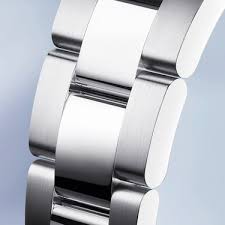
The Land-Dweller’s Flat Jubilee bracelet is perhaps the clearest modern connection. Like the bracelet of the Ref. 1630, it takes a recognizable Rolex design and adapts it to sit flush with an integrated case.
Rolex also offers the Land-Dweller in 36mm, the same diameter traditionally associated with the Ref. 1630, as well as a larger 40mm version.
Why the Land-Dweller Changes the Story of the Ref. 1630
Before the introduction of the Land-Dweller, the Rolex 1630 could easily be dismissed as an unusual side note from the quartz crisis.
It appeared to be a rare automatic watch placed inside a design that Rolex later reserved for the Oysterquartz. When Oysterquartz production eventually ended, the angular case and integrated bracelet seemed like a design direction the company had abandoned.
The Land-Dweller changed that interpretation.
By returning to an integrated case, fluted bezel, and flattened Jubilee-style bracelet, Rolex showed that the ideas found in the Ref. 1630 had not been forgotten. They remained part of the company’s design vocabulary for approximately half a century.
There is also a technical parallel.
The Ref. 1630 paired a radical new exterior with Rolex’s established Calibre 1570 during a period of technological change. The Land-Dweller uses a similarly distinctive design to introduce the advanced Calibre 7135 and Rolex’s new Dynapulse escapement.
Both watches connect important mechanical movements with unusually forward-looking Rolex design.
A Different Kind of Vintage Rolex
The 1970s produced several of the most celebrated integrated-bracelet watches ever made, including the Audemars Piguet Royal Oak, Patek Philippe Nautilus, and IWC Ingenieur SL.
The Rolex 1630 belongs to the same broader design era, but it approaches the idea differently.
Rather than abandoning traditional Rolex styling, the Ref. 1630 combines integrated-bracelet architecture with the familiar vocabulary of the Datejust: two-tone construction, a fluted bezel, a magnified date, and a chronometer-certified automatic movement.
It is neither a conventional dress watch nor a traditional sports watch.
It is a distinctly Rolex interpretation of 1970s integrated design.
What to Look for When Buying a Rolex 1630
Condition and originality are especially important when evaluating a Rolex Ref. 1630.
Start with the case. The flat planes, angular shoulders, and sharp transitions are central to the watch’s design. Excessive polishing can soften those details and make the case appear rounded.
Next, examine the bracelet. Look for the correct integrated construction and the three gold center elements associated with the Ref. 1630. Bracelet length and flex are also important because replacement links can be difficult to locate.
The dial, hands, and date wheel should be considered together. Consistent aging and correct typography are more meaningful than assuming every Ref. 1630 should have one universal dial configuration.
Finally, review the movement and service history. The Calibre 1570 is a respected and durable Rolex movement, but maintenance quality and replacement components still matter on a watch approaching 50 years of age.
Why the Rolex 1630 Matters
The Rolex Datejust Ref. 1630 matters because it captures Rolex during a rare period of visible experimentation.
It connects the company’s first quartz watch, its established automatic movements, the later Oysterquartz collection, and the modern Land-Dweller.
Few Rolex references touch so many different chapters of the brand’s history.
The Ref. 1630 is not simply an automatic Oysterquartz or an unusual vintage Datejust. It is evidence of Rolex exploring how its watches could look and function in a rapidly changing world.
The arrival of the Land-Dweller has made that story even more relevant.
What once appeared to be an isolated 1970s experiment can now be recognized as one of the clearest historical ancestors of a major modern Rolex collection.
That makes the Rolex Datejust Ref. 1630 a genuine Rare Bird—and one of the most compelling links between vintage and contemporary Rolex design.
Frequently Asked Questions
Is the Rolex 1630 an Oysterquartz?
No. The Rolex 1630 resembles the Oysterquartz, but it is powered by the automatic Rolex Calibre 1570.
When was the Rolex 1630 produced?
Known examples generally date from approximately 1975 through 1978, although Rolex has not published exact production dates.
How many Rolex 1630 watches were made?
Rolex has not confirmed a production total. An estimate of approximately 1,500 examples is often repeated, but it remains unverified.
Why is the Rolex 1630 called the Rare Bird?
The nickname refers to its unusual combination of an Oysterquartz-style integrated case and bracelet with a traditional automatic Rolex movement.
Did the Rolex 1630 inspire the Land-Dweller?
Yes. Rolex identified a self-winding Datejust from 1974—the Ref. 1630—as part of the historical integrated-design lineage behind the Land-Dweller.
What movement is inside the Rolex 1630?
The Rolex Datejust Ref. 1630 is powered by the automatic Rolex Calibre 1570.
What is the difference between the Rolex 1630 and 17013?
The Ref. 1630 uses an automatic mechanical movement. The Oysterquartz Ref. 17013 uses Rolex’s quartz Calibre 5035. Their bracelet constructions also differ.
Is the Rolex 1630 collectible?
Yes. Its short production period, unusual design, mechanical movement, integrated bracelet, and connection to the modern Land-Dweller make it increasingly interesting to vintage Rolex collectors.